
The Algorithm Wars
How AI Became Both Shield and Spear in Cybersecurity
🧠 Big Brain Energy
Strategic insights for the executive suite
The AI Paradox: When Your Best Defense Becomes Their Best Weapon
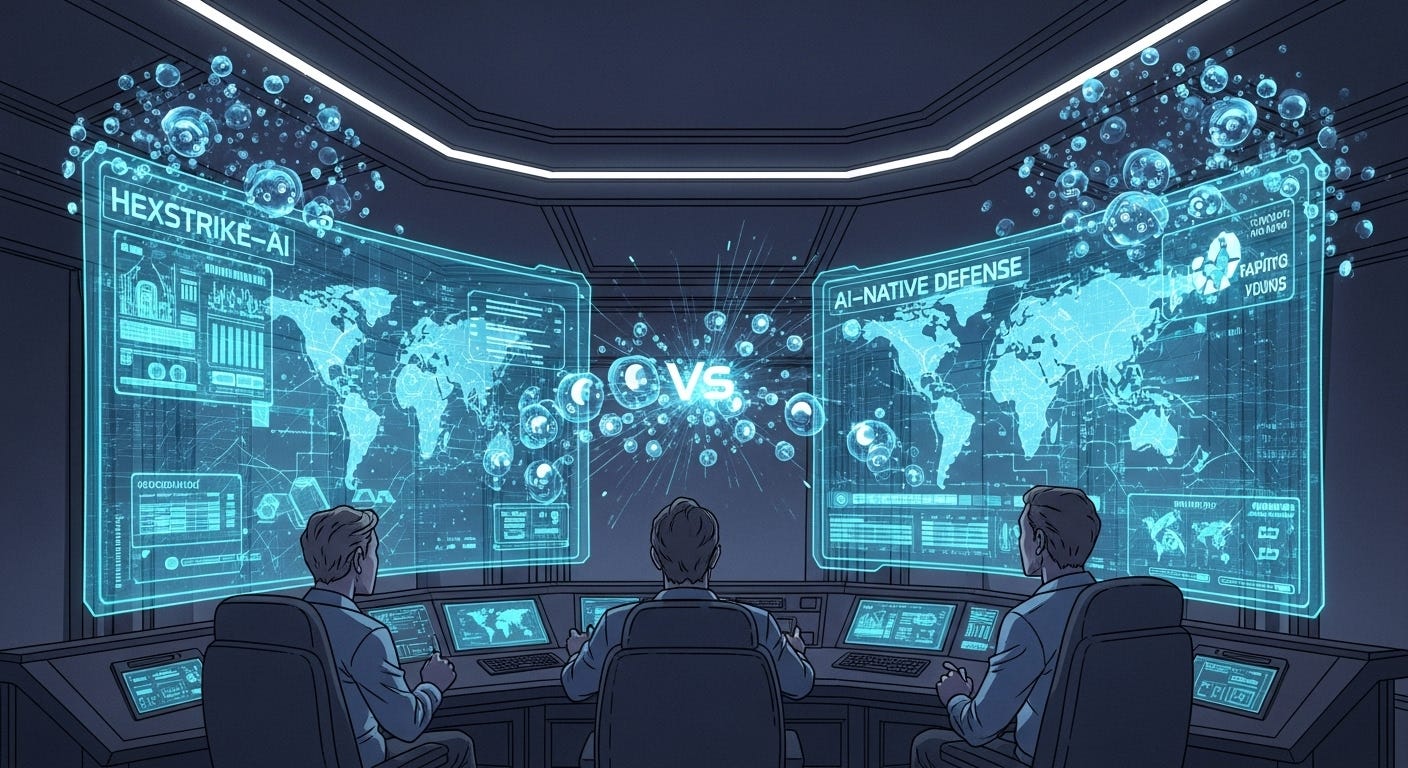
The week of September 8, 2025, marked a watershed moment in cybersecurity: the emergence of "Hexstrike-AI," a framework deploying 150+ specialized AI agents to compress attack lifecycles from days to minutes. This isn't just another tool—it's a paradigm shift that demands C-suite attention.
The Strategic Reality: AI-powered offensive frameworks like Hexstrike-AI can now automate vulnerability weaponization faster than human analysts can respond. Check Point's research reveals how threat actors repurpose "red team" AI frameworks to orchestrate multi-vector attacks with unprecedented speed and sophistication.
Executive Action Items:
Invest in AI-Native Defenses: Traditional signature-based detection is obsolete. Board-approved budgets must prioritize AI-driven security operations centers (SOCs) that can match machine speed with machine intelligence.
Establish AI Governance: With Europe's AI Act now enforcing fines up to 6% of global turnover, multinational enterprises need board-level AI risk management frameworks, not just IT policies.
Audit Your AI Supply Chain: Recent "Model Namespace Reuse" attacks compromise AI pipelines by injecting malicious code into trusted model repositories. Organizations need AI-specific software composition analysis (SCA) as urgently as they needed dependency scanning a decade ago.
Supply Chain Intelligence: Beyond Risk to Real-Time Response
The Salesloft Drift breach—exposing OAuth tokens across 700+ organizations including Cloudflare and Palo Alto Networks—illustrates how third-party AI integrations create exponential risk multiplication.
The Strategic Shift: Supply chain risk management must evolve into supply chain intelligence. Static vendor assessments are insufficient when AI-orchestrated attacks can pivot through vendor ecosystems in minutes.
Board-Level Imperatives:
Dynamic Vendor Scoring: Implement real-time vendor risk ratings that adjust based on threat intelligence, not annual assessments
Multi-Party Code Signing: Mandate cryptographic verification for all third-party integrations
Incident Response Integration: Your crisis management must include vendors' incident response readiness, not just their security controls
The Ransomware Evolution: From Encryption to Identity Extortion
Pennsylvania's Attorney General Office's public refusal to pay ransom—while maintaining operations through manual workarounds—signals a critical trend: sophisticated organizations are building ransomware resilience, forcing attackers to evolve tactics.
The New Threat Vector: Modern ransomware groups increasingly target identity systems (Azure AD, Okta) to compromise recovery mechanisms and multi-factor authentication. They're moving beyond encryption to identity-centric extortion.
Strategic Response Framework:
Zero-Trust Architecture: Not an IT project but a business resilience imperative requiring legal, HR, and finance coordination
Identity Protection Layers: Executive-sponsored continuous verification and micro-segmentation
Crisis Communication Plans: Board-approved playbooks for stolen data scenarios, beyond encrypted systems recovery
📡 Signal vs Noise
Current events that matter
AI Act Enforcement Begins: Europe designated national competent authorities by August 2, 2025, with binding technical controls and hefty penalties
Nation-State Activity Surge: Amazon disrupted APT29's watering hole operation targeting cloud authentication flows
Record DDoS Defense: Cloudflare autonomously mitigated 11.5 Tbps attack—largest recorded—demonstrating AI-scale cloud security
Healthcare Under Siege: 1M patient records stolen in AI-powered attack using deepfake authentication bypass
Critical Infrastructure Alert: CISA warns of exploited TP-Link vulnerabilities (CVE-2023-50224, CVE-2025-9377) ahead of CIRCIA reporting requirements
🎧📺 Queue It Up
Multimedia recommendations from the last 30 days
Podcasts
VikingCloud CyberIntel: "The AI Black Box Problem" - Brian Odian explores what has everyone so spooked about artificial intelligence
The FAIK Files: "Weapons, Whispers, and AI Gone Rogue" (Ep 17) - OpenAI's Anduril partnership, ElevenLabs Russian propaganda, and AI robot "kidnapping"
Palo Alto Cyber Dialogues: "Securing ASEAN's Digital Future" (Ep 8) - Regional AI governance and public-private partnerships
BarCode Security Podcast: Latest episodes on cybersecurity leadership and culture
Videos & Content
Microsoft Purview Data Security: "Building Layered Protection" - New browser and network controls for AI era
Gula Tech Adventures: "CVE 2025" and "Newton's Law of Cyber Offense" - Ron Gula's insights on vulnerability management
Ron Gula Unicon 2025 Keynote: Battle-tested lessons from NSA red teamer turned investor
📚 Brain Food
Featured resource of the week
"Not with a Bug, but with a Sticker: Attacks on Machine Learning Systems and What To Do About Them"
As AI-driven attacks become reality, this essential read explores how machine learning systems can be manipulated and defended. Perfect timing as organizations grapple with AI governance under new regulatory frameworks. Essential for CISOs building AI-native defense strategies.
⏰ Time Machine
Tech history that informs today
The Expert Systems Winter That Preceded Today's AI Spring
Before today's neural networks revolutionized cybersecurity, the 1980s saw AI's second wave: expert systems. These rule-based programs promised to encode human expertise into logical frameworks—a transparent "white box" approach opposite to today's "black box" neural networks.
The promise was compelling: cybersecurity experts could encode their knowledge into systems that would make consistent, explainable decisions. Companies like Symbolics and Inference Corporation built expert systems for everything from medical diagnosis to financial trading.
But by the late 1980s, the limitations became clear. Expert systems required human experts to manually encode every rule, every exception, every edge case. For cybersecurity applications, this meant systems that could identify known attack patterns but failed against novel threats—exactly the opposite of what defenders needed.
The "AI Winter" that followed (1974-1993) saw funding dry up and industry collapse. The lesson: AI approaches that can't adapt to unknown scenarios have limited security value.
Today's neural networks succeeded where expert systems failed by learning patterns from data rather than requiring manual rule encoding. But we're seeing echoes of the past: today's AI models struggle with explainability—the very strength of those 1980s expert systems.
The historical lesson for modern CISOs: AI approaches that promise perfect solutions often reveal unexpected limitations. Today's AI-powered security must be designed for adaptability, not just performance.
🎤 Mic Drop
Final thoughts for strategic leaders
The convergence of AI-powered offense and defense represents the most significant shift in cybersecurity since the internet's commercialization. We're not just witnessing tool evolution—we're experiencing a fundamental change in the speed and scale of cyber operations.
Executive leaders who treat AI security as an IT concern rather than a board-level imperative will find themselves managing crisis rather than competitive advantage. The organizations that thrive will be those that recognize AI isn't just changing their security tools—it's changing the entire threat landscape.
The question isn't whether AI will transform your security posture. The question is whether you'll lead that transformation or be transformed by it.
"In the age of AI-powered attacks, yesterday's best practices become tomorrow's vulnerabilities. The only sustainable defense is intelligent adaptation."
Generated with strategic intelligence for cybersecurity executives Issue Date: September 8, 2025